Free Commercial Kitchen Cleaning Schedule Template
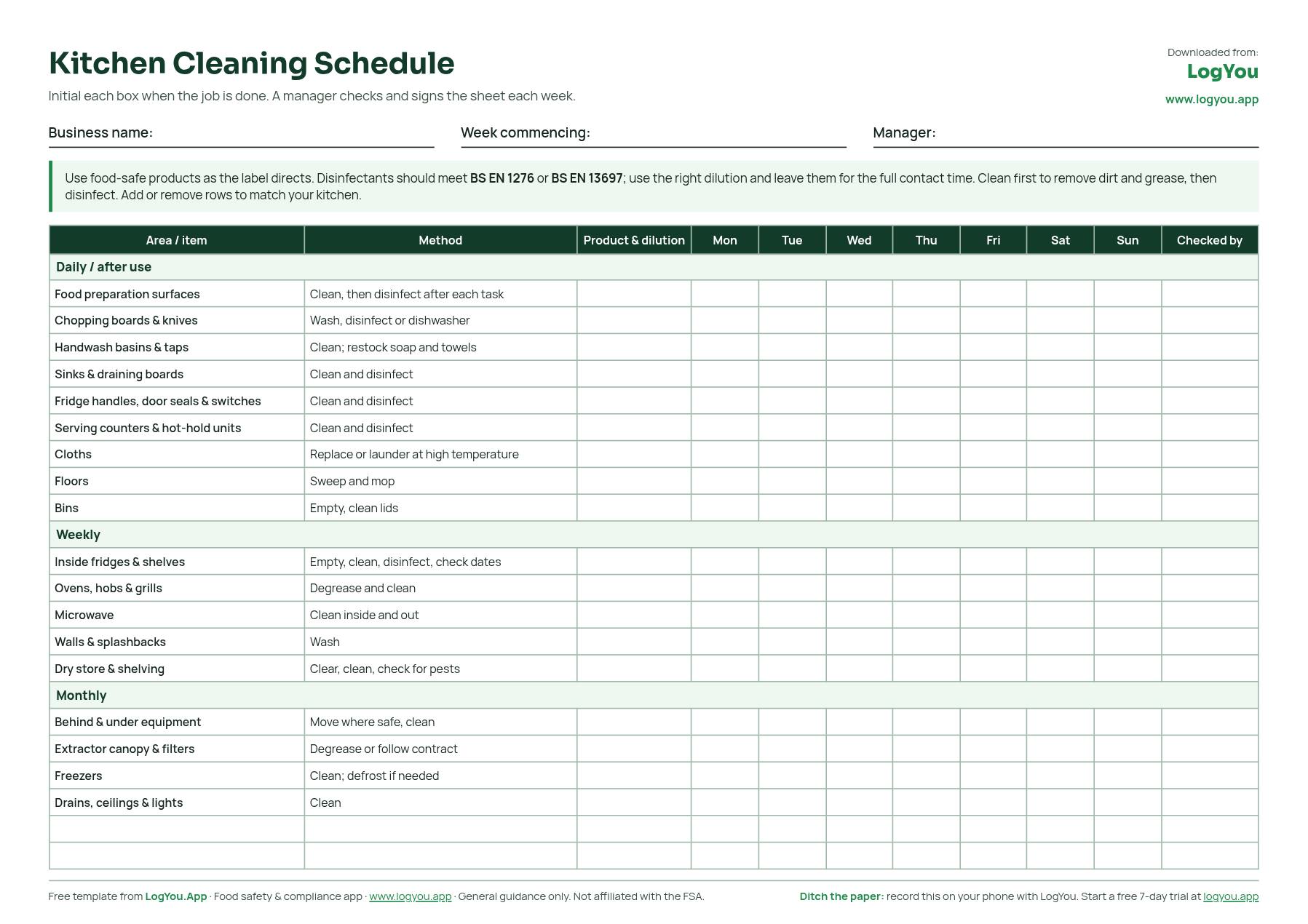
A weekly cleaning schedule with the common daily, weekly and monthly jobs already filled in. Add your own products and dilutions, then initial each job when it is done.
Kitchen cleaning schedule (PDF, 1 page, A4) · No sign-up needed
What's on the sheet
- 18 common kitchen jobs grouped into daily, weekly and monthly
- A method for each job and space for the product and dilution
- Monday to Sunday boxes for initials
- A 'checked by' column for the manager's weekly sign-off
- Blank rows for jobs specific to your kitchen
How to use it
- 1Walk your kitchen and adjust the list: add equipment you have and remove what you don't.
- 2Write the product and dilution for each job, as the product label directs.
- 3Staff initial the box for the day once the job is done.
- 4At the end of the week a manager checks the work, signs the sheet and follows up anything missed.
- 5Keep the sheets with your food safety records.
What a good cleaning schedule shows
Clean first to remove dirt and grease, then disinfect. Disinfectants should meet BS EN 1276 or BS EN 13697, used at the right dilution for the full contact time.
Food contact surfaces, chopping boards and anything touched often need cleaning and disinfecting after each task, not just at the end of the day.
The inspector looks at the condition of the kitchen as well as the paperwork, so the schedule should cover hard-to-reach areas too.
Your schedule should match your own Safer Food, Better Business (or equivalent) cleaning safe method.
General guidance only, not legal advice. Check the official sources below and your local authority for anything specific to your business.
Tired of paper sheets?
Do the same check on your phone with LogYou
In LogYou, cleaning jobs become daily, weekly, monthly or yearly Task Lists with due times, reminders and per-task sign-off. Missed jobs show on the dashboard, and you can attach photo proof.
Common questions
How often should a commercial kitchen be deep cleaned?
It depends on how busy the kitchen is and what you cook. Many kitchens deep clean weekly and plan a fuller clean of extraction and hard-to-reach areas less often. Your schedule should match the risks in your kitchen.
Do I have to keep a cleaning schedule?
You must keep your premises clean and have food safety procedures based on HACCP principles. A written cleaning schedule with sign-offs is a simple way to show that cleaning is planned and done.
What does BS EN 1276 mean on a disinfectant?
It is a standard showing the product has been tested to kill bacteria under set conditions. BS EN 13697 is a similar test on surfaces. Use the product at the dilution and contact time on its label.
More free templates
Official sources
Reviewed 13 November 2026. Linking to these sources does not imply their approval of LogYou.